Rupert Read: Powerful Philosophy, Climate Action and Public Leadership
The life, education, career, books, environmental ideas, political work, and public influence of British philosopher Rupert Read

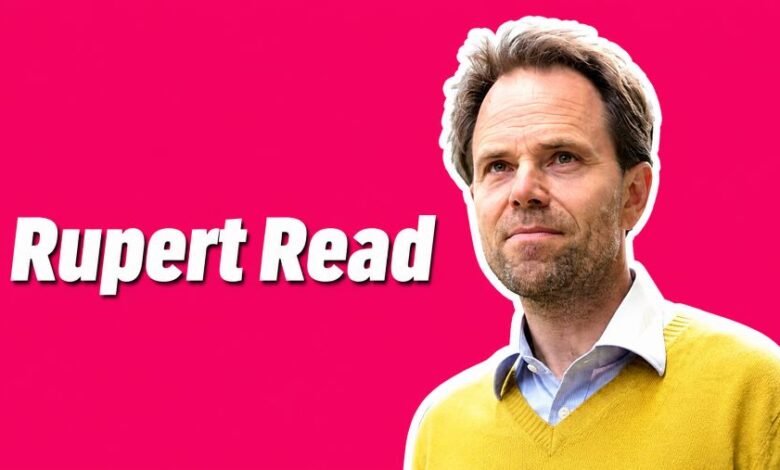
Introduction
Rupert Read is a British philosopher whose career has developed across academic philosophy, environmental thought, political engagement, and climate activism. Best known for his work on Ludwig Wittgenstein, philosophy of language, philosophy of science, film, and ecological philosophy, he has built a distinctive public profile by connecting philosophical ideas with some of the most urgent questions facing modern society.
His academic career was closely associated with the University of East Anglia, where he worked for 26 years before accepting voluntary severance in 2023. Alongside his university work, Rupert Read became involved in the Green Party, environmental campaigning, and Extinction Rebellion. He later helped establish the Climate Majority Project, focusing on practical collective action around climate change, ecological breakdown, adaptation, and resilience.
Quick Bio
| Field | Details |
|---|---|
| Full name | Rupert Read |
| Born | 1966 |
| Nationality | British |
| Profession | Philosopher, author, academic and environmental campaigner |
| Main academic field | Philosophy |
| Specialisms | Wittgenstein, philosophy of language, environmental philosophy, philosophy of science, philosophy and film |
| Undergraduate education | Balliol College, University of Oxford |
| Doctoral education | Rutgers University |
| Former institution | University of East Anglia |
| Political association | Green Party |
| Environmental movement | Extinction Rebellion |
| Current leadership role | Co-Director, Climate Majority Project |
| Academic status | Emeritus Associate Professor at UEA |
| Notable book | The New Wittgenstein |
| Other major works | Why Climate Breakdown Matters, Parents for a Future, Wittgenstein’s Liberatory Philosophy |
| Religious and spiritual interests | Quaker and Buddhist meditation |
| Main public focus | Philosophy, climate change, ecological breakdown and social transformation |
Early Life and Education
Rupert Read was born in 1966 and developed his professional life around philosophy. His university education began at Balliol College, Oxford, where he studied Philosophy, Politics and Economics and graduated with a First Class B.A. Honours degree in 1987. His Oxford education provided an interdisciplinary foundation that later became important to his work in philosophy, politics, economics, and environmental questions.
He subsequently studied philosophy at Rutgers University in New Jersey, where he spent several years working within a demanding philosophical environment. His teachers and intellectual influences included Jerry Fodor and Colin McGinn, while he also worked with figures such as James Guetti, Louis Sass, Saul Kripke, Alexander Nehamas, and Cora Diamond. His doctoral research concentrated on difficult questions surrounding Wittgenstein, Kripke, Goodman, language, rules, and philosophical scepticism.
Academic Career as a Philosopher
After completing his doctoral studies, Rupert Read taught at Rutgers and later held positions at Manchester Metropolitan University and the University of Manchester. In 1997, he joined the University of East Anglia, beginning a long academic association that would become one of the defining parts of his professional career.
At UEA, his research covered several interconnected areas. He became particularly associated with Wittgensteinian philosophy, philosophy of language, philosophy of science, philosophy of literature and film, psychology, and environmental philosophy. His academic interests gradually developed from questions about language and philosophical foundations toward wider questions concerning nature, society, politics, ecological risk, and humanity’s relationship with the natural world.
Wittgenstein and Philosophy of Language
A major part of Rupert Read’s intellectual identity comes from his engagement with Ludwig Wittgenstein. His doctoral dissertation explored sceptical readings of Wittgenstein and Nelson Goodman, while his later publications examined Wittgenstein’s philosophy from several perspectives.
His work helped contribute to wider discussions surrounding Wittgenstein’s approach to language, philosophical problems, rules, science, and human practices. His book The New Wittgenstein, edited with Alice Crary, became one of the notable works associated with the interpretation of Wittgenstein’s philosophy.
Philosophy and Film
Rupert Read also helped develop the field sometimes described as film as philosophy or film-philosophy. His work explored how cinema can raise philosophical questions rather than merely illustrate ideas already developed in academic philosophy.
This interdisciplinary approach reflects a wider feature of his career: he has consistently looked beyond conventional academic boundaries. Literature, cinema, science, psychology, politics, and environmental concerns have all become part of his philosophical investigations.
Environmental Philosophy and Climate Thought
The ecological dimension of Rupert Read’s philosophy became increasingly important throughout his career. His environmental work examines questions such as the precautionary principle, the value of nature, future generations, non-human life, ecological risk, and the limitations of conventional political and economic thinking.
His interest in the precautionary principle also brought him into collaboration with mathematician and risk thinker Nassim Nicholas Taleb and other researchers. Their work examined precaution in relation to uncertain but potentially catastrophic systemic risks. Read subsequently contributed evidence and arguments to British parliamentary discussions involving environmental and technological risk.
His environmental philosophy has developed into a broader critique of political and economic systems that struggle to respond adequately to ecological breakdown. Rather than treating climate change solely as a technical problem, Rupert Read has argued that it requires changes in institutions, values, political priorities, and collective behavior.
Political Career and Green Party Work
Rupert Read became active in Green Party politics and served as a Green Party councillor in Norwich from 2004 to 2011. During this period, he was involved in local political issues and served as a transport spokesperson. He also stood as a Green Party candidate in national and European elections.
His political work connected closely with his philosophical interests. He advocated environmental responsibility, precaution, ecological thinking, and stronger political recognition of environmental limits. He also contributed to Green Party policy discussions involving the precautionary principle and rights of nature.
Parliamentary and Public Policy Work
Beyond electoral politics, Read became involved in public policy debates. He submitted evidence to parliamentary committees on subjects including genetically modified crops and energy and climate policy. He also briefed Members of Parliament and Members of the House of Lords on the precautionary principle.
These activities demonstrate an important feature of his career: Rupert Read has not restricted philosophy to universities. He has repeatedly attempted to apply philosophical reasoning to real-world decisions involving environmental risk, political institutions, economics, and public policy.
Extinction Rebellion and Climate Activism
Rupert Read became one of the prominent public figures associated with Extinction Rebellion. He has described how, around 2015, he became increasingly convinced that civilization faced an extraordinary ecological challenge. After learning about the emerging Extinction Rebellion movement, he became involved in helping develop its public and political strategy.
During the major Extinction Rebellion actions in 2019, he served as a spokesperson and strategist and became involved in political discussions with government figures. His role placed him at the intersection of philosophy, environmental activism, media communication, and political negotiation.
The movement also generated criticism over disruption and protest tactics. Rupert Read has subsequently acknowledged that some activist approaches could alienate members of the public and has argued for a broader climate movement capable of bringing together a much larger section of society. His later work therefore represents both continuity with his environmental activism and a significant strategic evolution.
Climate Majority Project
In 2022, Rupert Read helped found the Climate Majority Project, where he serves as Co-Director. The project focuses on helping people who are concerned about climate and ecological breakdown understand their collective capacity to act.
The organization’s approach reflects Read’s developing emphasis on the idea of a climate majority. Instead of relying exclusively on highly disruptive protest, the approach seeks broader participation, collective organization, adaptation, resilience, and practical social transformation.
His recent work has increasingly addressed climate adaptation and preparedness. Through the Climate Majority Project, he has continued writing and speaking about national resilience, ecological risk, food security, and the need for societies to prepare for worsening climate impacts.
Major Books and Publications
Rupert Read has produced an extensive body of academic and public-facing writing. His published work includes books, edited collections, chapters, academic papers, reviews, and essays.
Selected Books
- The New Wittgenstein (2000), edited with Alice Crary
- Kuhn: Philosopher of Scientific Revolution (2002), with Wes Sharrock
- Film as Philosophy (2005), edited with Jerry Goodenough
- Philosophy for Life (2007)
- Applying Wittgenstein (2007)
- Wittgenstein among the Sciences (2012)
- A Wittgensteinian Way with Paradoxes (2012)
- This Civilisation is Finished (2019), with Samuel Alexander
- Extinction Rebellion: Insights from the Inside (2020), with Samuel Alexander
- Wittgenstein’s Liberatory Philosophy (2020)
- Parents for a Future (2021)
- Deep Adaptation (2021), edited with Jem Bendell
- Why Climate Breakdown Matters (2022)
- Do You Want to Know the Truth? (2022)
- The Climate Majority Project (2023)
- Transformative Adaptation (2024)
These books show the extraordinary range of his career, moving from analytical and Wittgensteinian philosophy toward environmental ethics, climate politics, adaptation, and social transformation.
Personal Life, Spirituality and Beliefs
Rupert Read has publicly discussed his connection with Quakerism and Buddhist meditation. His spiritual interests developed alongside his philosophical and environmental concerns and have influenced some of his reflections on society, ethics, nature, and human responsibility.
He became an attender of Quaker meetings while in the United States and later became a Quaker in Norwich. He has also described becoming a Buddhist meditator following experiences connected with travel in India and Nepal. These aspects of his life provide an important personal dimension to his broader interest in ethics, spirituality, ecological responsibility, and human flourishing.
Rupert Read is married and has spoken publicly about his family life in interviews. His public work, however, has generally concentrated much more heavily on philosophy, environmental issues, activism, and political ideas than on private family details.
Career Timeline
1984–1987: Oxford University
Studied Philosophy, Politics and Economics at Balliol College, Oxford, graduating with First Class Honours.
1988–1995: Rutgers University
Completed doctoral research in philosophy, concentrating on Wittgenstein, Goodman, scepticism, language, and philosophical foundations.
1995–1997: Manchester
Held teaching positions at Manchester Metropolitan University and the University of Manchester.
1997–2023: University of East Anglia
Built a long academic career at UEA, becoming an Associate Professor and contributing extensively to philosophy teaching, research, postgraduate supervision, and interdisciplinary environmental studies.
2004–2011: Norwich City Council
Served as a Green Party councillor and participated in local political work.
2010s: Environmental and Political Engagement
Expanded his public work on environmental philosophy, precaution, ecological economics, and climate policy.
2019–2020: Extinction Rebellion
Served as a prominent spokesperson and strategist during the movement’s major period of public mobilization.
2022–Present: Climate Majority Project
Helped establish the Climate Majority Project and became its Co-Director, concentrating on climate action, adaptation, resilience, and wider public participation.
2023–Present: Public Philosophy and Climate Work
After leaving his long-term UEA role, he increasingly focused on climate movement strategy, environmental philosophy, public communication, and transformative adaptation.
Awards, Fellowships and Professional Recognition
Rupert Read’s career includes several academic fellowships, research appointments, and professional roles. These include a European University Institute Visiting Fellowship, Rutgers Excellence Fellowships, a visiting scholar position at the University of Chicago, and research support from UK academic funding bodies.
He was also shortlisted for the International Society for Environmental Ethics’ Andrew Light Award for Public Philosophy in 2020. His professional service has included work connected with the Wittgenstein Archive, editorial roles, environmental research groups, and interdisciplinary academic projects.
Positive Contributions and Criticism
One of Rupert Read’s strongest contributions has been his ability to connect academic philosophy with public environmental debates. His writing demonstrates how philosophical questions about language, ethics, science, risk, and political responsibility can become relevant to practical challenges.
At the same time, his association with Extinction Rebellion placed him within contentious debates about protest tactics, disruption, and political effectiveness. Critics of disruptive climate activism have questioned whether such methods build or reduce public support. Read’s own more recent emphasis on a broad climate majority suggests that his thinking has evolved in response to these strategic difficulties.
Current Influence and Legacy
Rupert Read’s intellectual legacy is unusual because it crosses several fields. He is recognized as a philosopher of Wittgenstein and language, but his public identity increasingly includes environmental philosophy, climate activism, political strategy, and ecological resilience.
His continuing work with the Climate Majority Project places him within a newer phase of his career. Rather than focusing primarily on university philosophy, he now works to translate philosophical and environmental ideas into collective responses to climate breakdown. His books and public activities provide a record of that transition from academic philosopher to highly engaged public intellectual.
Conclusion
Rupert Read has developed a distinctive career that combines philosophy, environmental ethics, political engagement, activism, and public communication. His early academic work was strongly influenced by Wittgenstein and philosophical questions about language and scepticism, while his later career increasingly focused on ecological risk, climate change, precaution, and the future of civilization.
His journey also shows a willingness to reconsider strategy. From Green Party politics and Extinction Rebellion to the Climate Majority Project, Rupert Read has continued searching for ways to turn ideas into meaningful collective action. Whether considered primarily as a philosopher, author, environmental thinker, or climate campaigner, his work reflects a sustained attempt to understand difficult problems and encourage society to respond to them.
Frequently Asked Questions
1. Who is Rupert Read?
Rupert Read is a British philosopher, author, environmental thinker, and Co-Director of the Climate Majority Project.
2. When was Rupert Read born?
Rupert Read was born in 1966.
3. Where did Rupert Read study?
He studied Philosophy, Politics and Economics at Oxford’s Balliol College and completed his PhD in philosophy at Rutgers University.
4. Is Rupert Read married?
Yes, Rupert Read has publicly referred to his wife and family life.
5. What is Rupert Read’s religious or spiritual background?
He is publicly associated with Quakerism and has also described himself as a Buddhist meditator.
6. What does Rupert Read do professionally?
He works as a philosopher, author, environmental thinker, public speaker, and climate movement strategist.
7. Was Rupert Read involved with Extinction Rebellion?
Yes, he became a prominent Extinction Rebellion spokesperson and strategist during its major 2019 campaigns.
8. What is Rupert Read’s most recent major organization?
He is Co-Director of the Climate Majority Project, which focuses on collective climate action, adaptation, and resilience.