A. C. Grayling: Powerful Ideas From a Leading British Philosopher
His remarkable journey through philosophy, humanism, education, and public debate

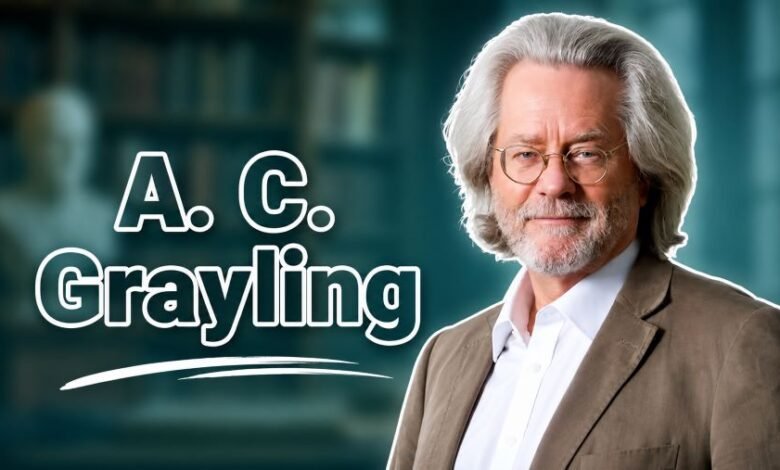
Introduction
A. C. Grayling is one of Britain’s best-known contemporary philosophers and authors, with a career that has connected academic philosophy with journalism, education, literature, and public debate. Born Anthony Clifford Grayling on 3 April 1949 in Luanshya, then Northern Rhodesia and now Zambia, he developed an international intellectual profile through books that examine knowledge, religion, ethics, democracy, war, and the history of ideas.
As a British philosopher and author, Grayling has also played an important role in making philosophical questions accessible to general readers. His career includes professorship at Birkbeck, the founding of New College of the Humanities, service as chair of the 2014 Man Booker Prize judges, and continuing academic leadership at Northeastern University London.
Quick Bio
| Category | Details |
|---|---|
| Full Name | Anthony Clifford Grayling |
| Known As | A. C. Grayling |
| Date of Birth | 3 April 1949 |
| Birthplace | Luanshya, Northern Rhodesia, now Zambia |
| Nationality | British |
| Profession | Philosopher, author, academic, educator |
| Education | University of Sussex, University of London, University of Oxford |
| Doctorate | DPhil in Philosophy, University of Oxford |
| Main Fields | Philosophy, ethics, epistemology, logic, humanism |
| Current Academic Role | Principal and Professor of Philosophy, Northeastern University London |
| Oxford Role | Supernumerary Fellow, St Anne’s College |
| Honours | CBE, FRSL, FRSA |
| Known Works | The God Argument, The Good Book, The History of Philosophy |
Early Life and Family Background
Anthony Clifford Grayling was born in Luanshya in Northern Rhodesia in 1949. He spent much of his childhood in Africa, an experience that gave his early life a distinctive geographical and cultural background. His father, Henry Clifford Grayling, worked in banking, while his mother was Ursula Adelaide Grayling, née Burns.
Grayling attended Falcon College in what was then Southern Rhodesia, now Zimbabwe. His early interest in philosophy developed while he was still young, eventually leading him toward formal study and an academic career. His childhood experiences were followed by higher education in Britain, where philosophy became the central focus of his professional life.
Education and Philosophical Development
Grayling studied philosophy at the University of Sussex and the University of London before continuing his education at the University of Oxford. His university studies gave him a strong foundation in analytical philosophy and encouraged his interest in questions concerning knowledge, skepticism, logic, language, and the nature of philosophical argument.
At Oxford, Grayling completed doctoral research on epistemological skepticism and transcendental arguments. He received his DPhil in 1981. His academic development was influenced by important philosophers including A. J. Ayer and P. F. Strawson, helping shape the rigorous analytical approach that became an important feature of his later writing.
Academic Career
Grayling began his teaching career at institutions including Bedford College and St Anne’s College, Oxford. He later joined Birkbeck, University of London, where he developed a long academic career and became Professor of Philosophy.
His work at Birkbeck established him as a respected academic philosopher while his books and newspaper writing increasingly introduced him to readers outside universities. This combination of specialist scholarship and public communication became one of the defining features of his professional identity.
Grayling has also maintained a connection with Oxford as a Supernumerary Fellow of St Anne’s College. His continuing relationship with academic institutions reflects the importance of teaching and scholarship throughout his career.
Founding New College of the Humanities
One of Grayling’s most significant educational achievements came in 2011, when he founded New College of the Humanities in London. He became the institution’s first head and helped establish an educational model centered strongly on humanities education.
The institution later became part of Northeastern University and developed into Northeastern University London. Grayling continues to serve as Principal and Professor of Philosophy, giving him a prominent role in contemporary higher education.
The creation of the college represents both a positive achievement and a source of debate surrounding his career. Supporters saw the institution as a way of emphasizing intensive humanities education, while critics questioned aspects of its educational model and structure. Nevertheless, founding the institution remains one of the most distinctive accomplishments of his career.
Career as a British Philosopher and Author
Grayling has written extensively across several areas of philosophy. His interests include epistemology, ethics, philosophical logic, metaphysics, philosophy of language, humanism, political philosophy, and the history of ideas.
His writing style often combines philosophical reasoning with accessible explanations. Instead of limiting philosophy to specialist academic audiences, he has consistently explored questions that affect ordinary public life. Religion, morality, freedom, democracy, war, knowledge, and human values are recurring themes in his work.
This approach has helped establish Grayling as a prominent British philosopher and author whose influence extends beyond university departments.
Major Books and Popular Works
Grayling has written and edited more than 30 books. His bibliography includes academic studies, philosophical introductions, essays, historical works, and books aimed at general readers.
Among his best-known publications is The God Argument, in which he examines arguments surrounding God and presents a case for humanism. The book helped strengthen his public reputation as a prominent secular thinker.
Another major work is The Good Book, a large collection of philosophical, ethical, and literary material presented as a secular humanist work. It reflects Grayling’s interest in developing ethical and intellectual resources independent of traditional religious scripture.
His History of Philosophy is among his most ambitious books. Published in 2019, it surveys philosophical traditions across history and gives readers a broad introduction to the development of philosophical thought.
Other notable works include The Age of Genius, War: An Enquiry, Democracy and Its Crisis, The Good State, The Frontiers of Knowledge, For the Good of the World, Who Owns the Moon?, and Discriminations.
Humanism and Secular Thought
Humanism is an important part of Grayling’s public intellectual identity. He has argued extensively for reason, evidence, human welfare, freedom of thought, and ethical responsibility.
His criticism of religious arguments has sometimes made him a controversial figure. Supporters value his direct defense of secular humanism, while critics have challenged aspects of his arguments about religion. This disagreement has nevertheless helped keep his philosophical work at the center of wider public discussions.
Grayling’s humanist activities have included involvement with Humanists UK and other organizations associated with secularism, civil liberties, and human rights.
Journalism and Public Communication
Grayling has not restricted himself to books and university teaching. He has written for major British newspapers and magazines, including The Guardian, The Times, Prospect, the Financial Times, and other publications.
His journalism has allowed him to address current political, social, ethical, and cultural questions. He has also appeared on radio and television programmes, helping bring philosophy into mainstream public discussion.
His ability to explain complex ideas for non-specialist audiences has become a major part of his public reputation.
Booker Prize Career
Grayling has an important connection with the Booker Prize. He served as a judge on the prize panel in 2003 and later became chair of the judging panel for the 2014 Man Booker Prize.
The role placed him alongside leading figures from British literary and cultural life and demonstrated the breadth of his reputation beyond academic philosophy.
His involvement with the Booker Prize also illustrates how his career has crossed traditional boundaries between philosophy, literature, journalism, and education.
Awards and Honors
Grayling has received several notable honors during his career. He was appointed Commander of the Order of the British Empire, or CBE, in 2017 for services to philosophy.
He is also a Fellow of the Royal Society of Literature and a Fellow of the Royal Society of Arts. These distinctions reflect recognition of his contributions not only to philosophy but also to literature and wider intellectual life.
Career Timeline
1949
A. C. Grayling was born in Luanshya, Northern Rhodesia, now Zambia.
Childhood
He spent much of his childhood in Africa and attended Falcon College.
University Years
He studied philosophy at the University of Sussex and the University of London before pursuing doctoral research at Oxford.
1981
He completed his DPhil in Philosophy at Oxford.
1980s
Grayling developed his academic career while publishing philosophical research and books.
1991
He joined Birkbeck, University of London.
2005
He became Professor of Philosophy at Birkbeck.
2011
He founded New College of the Humanities in London.
2014
He chaired the Man Booker Prize judging panel.
2017
He received the CBE for services to philosophy.
2019
He published The History of Philosophy.
2020s
He continued publishing books, participating in public discussions, and working in higher education.
2025–2026
His recent work includes Who Owns the Moon? and Discriminations, while he continues his academic leadership at Northeastern University London.
Personal Life
Grayling has kept many aspects of his private life away from public attention. He was married to novelist Katie Hickman, and publicly available biographical information identifies three children.
His public identity is primarily associated with philosophy, writing, education, and intellectual debate rather than celebrity culture. Consequently, detailed claims about private friendships, personal routines, possessions, or other intimate matters should not be treated as established facts unless directly supported by reliable sources.
Achievements and Legacy
A. C. Grayling’s career is notable because he has successfully combined several roles. He has been an academic philosopher, university leader, author, journalist, broadcaster, literary judge, and humanist campaigner.
His books have helped introduce philosophical subjects to broad audiences, while his academic career has kept him connected to professional philosophical scholarship. His founding of New College of the Humanities represents a particularly significant contribution to British higher education.
His legacy is therefore not limited to one philosophical argument or publication. It is connected to his wider effort to make reasoned philosophical discussion part of everyday public life.
Recent Work and Continuing Influence
Grayling remains professionally active. His recent publications continue to address major questions about society, knowledge, culture, politics, and humanity’s future.
His continued position at Northeastern University London also demonstrates that education remains central to his work. At the same time, his books and public appearances continue to give him a platform for discussing philosophy with audiences far beyond traditional academic circles.
His career demonstrates the continuing public relevance of philosophy, particularly when philosophical ideas are connected with questions about how societies should live, govern themselves, and respond to uncertainty.
Conclusion
A. C. Grayling has built a remarkable career as a British philosopher and author by combining academic scholarship with public writing and educational leadership. From his early life in Africa and philosophical education in Britain to his professorship, book publishing, humanist advocacy, and founding of New College of the Humanities, his professional journey has covered a wide intellectual landscape.
His strongest contribution may be his determination to bring philosophy into public conversation. While some of his arguments have attracted criticism and disagreement, his willingness to address difficult questions openly has helped maintain public interest in philosophy. His books on religion, democracy, war, knowledge, ethics, and the history of philosophy continue to form the central body of his intellectual legacy.
Frequently Asked Questions
1. Who is A. C. Grayling?
A. C. Grayling is a British philosopher, author, academic, educator, and public intellectual.
2. What is A. C. Grayling’s real name?
His full name is Anthony Clifford Grayling.
3. When was A. C. Grayling born?
He was born on 3 April 1949.
4. Where was A. C. Grayling born?
He was born in Luanshya, Northern Rhodesia, now Zambia.
5. Who are A. C. Grayling’s parents?
His parents were Henry Clifford Grayling and Ursula Adelaide Grayling, née Burns.
6. Who is A. C. Grayling’s wife?
He was married to novelist Katie Hickman.
7. How many children does A. C. Grayling have?
Public biographical sources identify three children.
8. What is A. C. Grayling famous for?
He is especially known for his philosophy books, secular humanism, public writing, and The History of Philosophy.
9. What did A. C. Grayling found?
He founded New College of the Humanities in London in 2011.
10. What is A. C. Grayling’s most famous book?
Among his best-known books are The God Argument, The Good Book, and The History of Philosophy